
Reviewed · STOCKHOLM
Stockholm Must Sees
Old Town history, plus the Vasa ship. This Stockholm combo tour strings together medieval streets, royal landmarks, and then a short ferry ride to the Vasa Museum, all with a guide keeping things moving.
I love the way it gives you big, visual landmarks in a tight loop: Stortorget, Storkyrkan, and all those little story details like the Iron Boy and the St. George statue. I also like that the Vasa side isn’t just a free-for-all. You get a guided walkthrough on-site, plus you enter with your tickets already handled.
One possible drawback: the pace is brisk and you’re on cobblestones for a chunk of the day. If you want a slow, museum-style wandering morning, you’ll likely want extra time after the tour ends.
In This Review
- Key things I’d plan around
- Gamla Stan to Vasa: a smart 3-hour introduction to Stockholm
- Stortorget and Prästgatan: the Old Town starting line
- Storkyrkan and the Royal Palace area: where power gets personal
- Mårten Trotzig’s 90 cm alley: a quick win for your camera roll
- Skeppsbron ferry ride to Djurgården: a scenic reset between worlds
- The Vasa Museum with a guide: standing next to 98% intact history
- Walking, timing, and group size: what to expect on the ground
- Who this tour fits best in your Stockholm plan
- Guides and pacing: why “how it’s said” changes the day
- Should you book this Stockholm combo tour?
- FAQ
- How long is the tour?
- Where does the tour start?
- What is the price per person?
- What time does the tour start?
- What’s included in the ticket price?
- Is Vasa Museum admission included, and do you skip the line?
- How many people are in the group?
- Where does the tour end?
- Is the tour mostly walking?
Key things I’d plan around
- Gamla Stan in one go: Old Town highlights clustered into one efficient morning
- A short ferry break: a scenic public ride that doubles as transport to Djurgården
- Vasa Museum entry is handled: you get included tickets and a guided visit
- Small group size: up to 16 people, which helps keep the tour conversational
- A packed route: expect a mix of photos, stories, and frequent short walks
Gamla Stan to Vasa: a smart 3-hour introduction to Stockholm
If Stockholm is your first stop in Scandinavia, this tour makes a lot of sense. You start in the core of Gamla Stan, the Old Town, where the streets feel like they were built for feet and horses—not cars. Then you shift to Djurgården and the Vasa Museum, where Sweden’s maritime past turns into something you can stand next to and actually see.
The best part is the time logic. In just about 3 hours, you get two of the city’s most talked-about experiences: the iconic Old Town sites and the Vasa ship. For a first day, that’s huge. It helps you understand what Stockholm is proud of—royalty and church power on one side, and ambitious naval engineering on the other.
Value-wise, the price feels more reasonable than it might at first glance because the cost isn’t only “a guide.” Your Vasa Museum entrance is included, along with a public transport ticket to reach the museum area. You’re also spending time on a public ferry, which is part of the experience, not an extra bill you have to plan for.
Still deciding? Here is where this trip sits among the Stockholm tours our readers book most.


Stortorget and Prästgatan: the Old Town starting line
You meet at Stortorget, Stockholm’s oldest town square. It’s the kind of place where your brain automatically slows down. The buildings and cobbles make you understand why this spot has always mattered.
From there, the tour walks you toward Prästgatan, the Priest Street area. This is where you get the darker side of medieval storytelling—specifically, how certain parts of the street were once believed to be tied to the resting place of the dead. It’s not just spooky trivia. The point is how daily life, religion, and fear shaped the way people moved through the city.
At this stage, I also think the tour does something practical: it teaches you what to look for in Old Town. When you’re later wandering on your own, you won’t just see pretty streets—you’ll notice the street meanings, the church presence, and the way the neighborhood design reflects old priorities.
How long you’ll spend here: each Old Town stop is short—think in terms of ten-to-fifteen minute story blocks—so you get orientation without getting stuck in any one spot too long.
Storkyrkan and the Royal Palace area: where power gets personal
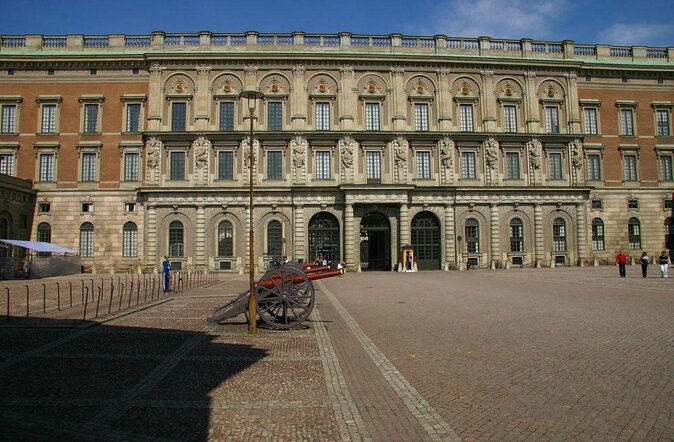
Next you move into the Royal Palace and church zone, one of the most important clusters in central Stockholm.
The Royal Palace is not some empty monument. It’s the official residence of the Swedish royal family, and it’s also a working place where parts of the monarchy’s public representation take place. The “big palace energy” here isn’t just size; it’s function. Even if you don’t go deep into rooms, you’re standing in the core of the system.
Right nearby is Storkyrkan (Stockholm Cathedral). This is one of the oldest buildings in the area, and it’s also where major royal weddings have happened, including the king and queen’s marriage. The guide’s storytelling at this stop matters because it helps connect the building to specific modern moments, not only medieval ones.
Inside Storkyrkan, you get to understand the symbolism behind the St. George and the Dragon motif. The tour notes that there’s a bronze copy outside, while the original sculpture is inside the cathedral and is made of wood. That detail is a great example of how a guide helps you see one landmark through multiple layers.
Then there’s a fun stop that works even if you’re not a statue person: Järnpojken, the Iron Boy (the Boy looking at the Moon). The tour frames it as the smallest statue in Sweden, which makes it easy to remember later. It’s the kind of quick photo stop that also gives you a sense of local personality—Stockholm doesn’t only worship grandeur.
Consideration: these sites are close together, but the tour only spends a short time at each. If you want to linger for architecture details or interior views, you’ll treat this as a sampler and plan follow-up time on your own.
Mårten Trotzig’s 90 cm alley: a quick win for your camera roll
One of the most memorable Old Town moments comes from Mårten Trotzigs grand—often shortened to Mårten Trotzig’s alley. At its narrowest, it’s about 90 cm wide. Even if you’ve seen “narrowest alley” claims online, the tour’s practical framing helps: yes, it’s famous, but you should also know that some guidebook superlatives don’t always hold up.
The point here isn’t just the novelty of squeezing through. It’s the contrast. This alley shows how Old Town streets were built for older forms of transport and everyday life. When you step into that tiny corridor, you can almost picture carts, animals, and foot traffic instead of modern movement.
If you’re traveling with family or friends who like oddball facts, this stop lands well. It’s fast, visual, and it breaks up the heavier royal-and-church theme so you don’t feel like you’re marching from one “serious landmark” to another.
Skeppsbron ferry ride to Djurgården: a scenic reset between worlds

After the Old Town walk, you hop on a public ferry. The route runs from the Skeppsbron 26 area, and the key benefit is simple: you get water views while also moving toward Djurgården without stress.
This ride is more than transport. Stockholm is an archipelago city, and the water is part of the identity. From the ferry, you get photo angles that you can’t get from street level. It also works like a mental reset. If the morning has been cobblestones and close quarters, the ferry adds space and light.
You’ll likely get some guidance on where to look from the water as you approach the Vasa Museum area. Even if you don’t memorize every direction, the ferry helps you understand Stockholm’s layout faster, which makes later self-guided wandering easier.


The Vasa Museum with a guide: standing next to 98% intact history

Then comes the main event: the Vasa Museum on Djurgården.
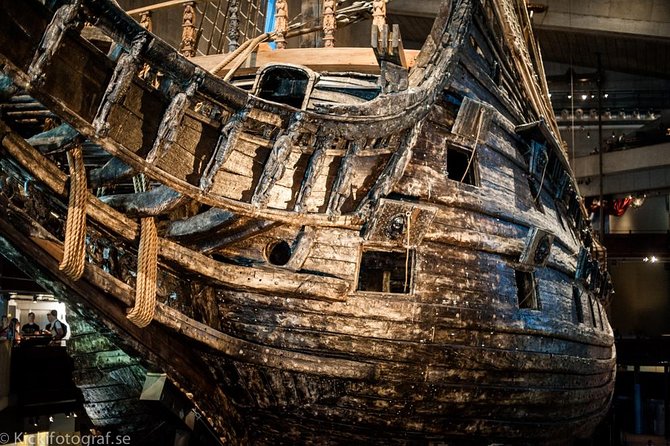
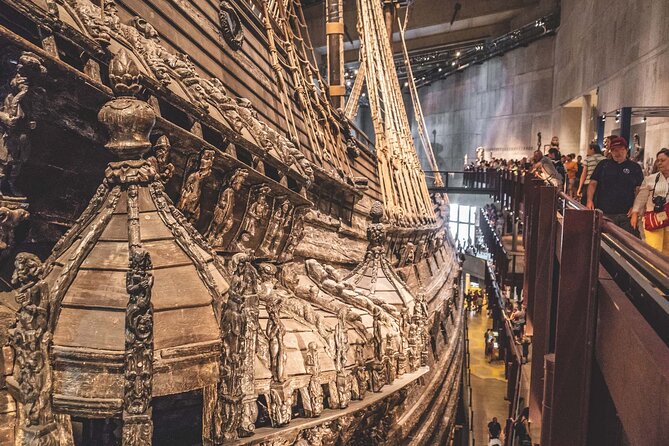
Here’s why this museum matters: the tour frames Vasa as a 1600s warship that sank on its maiden voyage and today is preserved at about 98% intact. That number is a big deal. Many shipwreck stories you hear are about what’s left. With Vasa, you’re seeing something that’s unusually complete, and that changes the whole experience from “learning about a disaster” to “studying a real vessel in detail.”
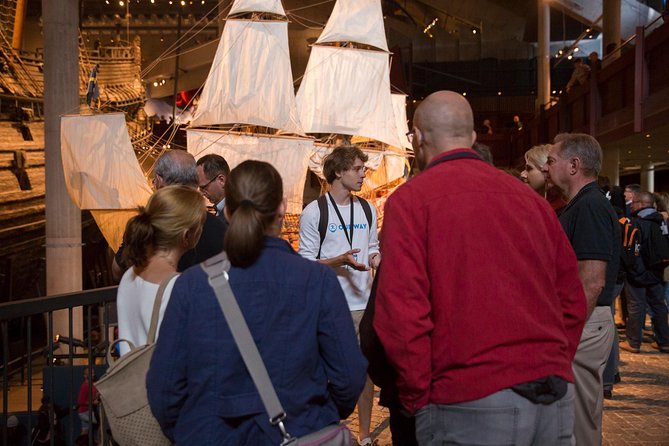
Your time inside is about one hour, and the tour includes skip-the-line entry. That’s worth taking seriously. The Vasa Museum can be popular, and saving time on the queue means you spend more of your limited tour window looking and less time standing.
During the guided portion, you’ll learn the story of why the Vasa mattered to Sweden in the 17th century—described as the most expensive and richly ornamented naval vessel of its era. You also get the human side of the disaster: the people along the shore were eyewitnesses, and they watched the ship capsize and sink in the Stockholm harbor.
After the guide finishes, the tour ends at the museum. That’s a smart design if you like control. You can extend the experience at your own pace, spend extra time at the areas that clicked, or move on to other nearby museums.
One more practical point I like: the guide doesn’t leave you completely on your own at the start. Coming in with context makes it much easier to choose what to focus on during your independent time inside the museum.
Walking, timing, and group size: what to expect on the ground

This tour is roughly 3 hours, starts at 10:00 am, and has a maximum group size of 16. In practice, that small number matters. A small group generally means more questions, clearer directions, and a better chance you’ll actually hear the guide at each stop.
Still, the negative review you should take seriously is the one about hearing the guide. If you know you have trouble hearing in groups, pick a position where you can see and face the guide during the walking parts.
What about physical demands? The tour notes moderate physical fitness and a lot of walking on cobblestones. That means good walking shoes are not a “nice-to-have.” Go with something with grip and support. If the weather is wet, cobbles become slippery quickly.
The good news: the route is built for this reality. Most stops are short. You’re not trapped in a long line of standing around at one site for the whole time. The combination of short stories plus a ferry helps keep energy from draining too fast.
Also, the tour runs in all weather conditions, so dress like you might walk through light rain. Bring a layer you can live in, not something fragile you’re afraid to get damp.
Who this tour fits best in your Stockholm plan

I’d book this tour if you’re:
- Doing Stockholm as a first-time visit and want a clean orientation
- Short on time but still want both Old Town and Vasa
- The type who likes stories tied to real places—street meanings, statues, and church symbolism
- Traveling with adults who can handle short walks on cobblestones
It’s also a strong fit for people who want a plan for their first morning. Starting at Stortorget and finishing at the Vasa Museum means you end near a major attraction, so you can keep going right away instead of guessing what to do next.
If you’re a hardcore museum person who wants hours in exhibitions, I’d still consider this. Use it as the framework. You’ll likely want extra time at Vasa after, but you’ll understand what you’re looking at much faster.
Guides and pacing: why “how it’s said” changes the day
Part of what makes this experience work is the guide approach. The reviews reflect a pattern: guides tend to keep an even pace and answer questions, with a clear focus on Swedish history and culture. Names that have shown up include Kevin, Ebba, Ebba, Katrin/Katerin, Joel, and Marita—so if your guide is one of these, you may get that confident, organized feel.
Even without knowing your guide ahead of time, you can plan for the style: short, story-led stops in Old Town; then a more focused guided component at the Vasa Museum, followed by self-guided time.
One watch-out: there’s also a note that the tour can feel like a fast pass. That doesn’t mean it’s bad. It means your expectations should match the format: you’re getting highlights and context, not a slow, deep study of every interior detail.
Should you book this Stockholm combo tour?
I think you should book it if you want the most “starter Stockholm” you can get in the least complicated way. It hits the two headline experiences—Gamla Stan and the Vasa Museum—and it does it with guided context that makes your later wandering more satisfying.
Skip it only if you know you want long, unhurried time in buildings and galleries right away. This tour is built for getting oriented fast, not for staying until your brain fully melts into one single attraction.
If you’re visiting on a tight schedule, this is one of the better ways to spend a morning: you’ll leave with a mental map of Old Town, a stronger grasp of what the Vasa ship represents, and a clear next step inside the museum once the guide is done.
FAQ
How long is the tour?
It’s about 3 hours.
Where does the tour start?
The meeting point is Stortorget 2, 114 44 Stockholm.
What is the price per person?
The price is $113.48 per person.
What time does the tour start?
The start time is 10:00 am.
What’s included in the ticket price?
You get a professional guide, Vasa Museum entrance, and a public transport ticket to the Vasa Museum (including the ferry portion used to get there).
Is Vasa Museum admission included, and do you skip the line?
Yes. Your Vasa Museum entrance is included, and the tour includes skip-the-line entry for the museum.
How many people are in the group?
The tour has a maximum of 16 travelers.
Where does the tour end?
It ends at the Vasa Museum (Galärvarvsvägen 14, 115 21 Stockholm), and you return on your own.
Is the tour mostly walking?
Yes. The tour involves walking on cobblestones, and it’s listed for moderate physical fitness in all weather.