
Reviewed · GAMLA STAN OLD TOWN WALKS
The Story of Stockholm and Sweden in Three Chapters, a Small Group Walking Tour
Sweden unfolds one street at a time. This small-group walking tour turns Stockholm’s Old Town into a readable timeline, moving from early settlements to modern peace and welfare.
You’re guided through three chapters of Swedish history with stops placed at real landmarks, statues, and political sites. You also get a story-driven route that feels less like sightseeing and more like following a plot.
What I like most is the way the tour uses included admission so you don’t burn time in lines, then blends that access with clear explanations you can actually remember later. I also love the focus on specific figures and turning points, like Birger Jarl, Gustav Vasa, and Gustav II Adolf, because it makes the city’s symbols click fast.
One possible drawback: it’s history-heavy. If you’re after long views and photo breaks, you’ll still get some, but expect more talking than wandering.
In This Review
- Key points you’ll feel during the walk
- Three chapters that make Stockholm feel like a timeline
- Price and logistics: what $61.28 really buys
- Chapter one: Riddarholmen and the early idea of Stockholm
- Stop 1: Riddarholmen historical marker (and a look at palace spaces)
- Stop 2: Riddarholmen Church area and Birger Jarl’s signature moment
- Chapter two: Gustav Vasa, the House of Nobility, and the reshaping of the state
- Stop 3: Outside Riddarhuset with Gustav Vasa and the Bloodbath of Stockholm
- Stop 4: Vasabron and the heirs of Gustav Vasa
- Chapter three: from estates and voting rights to the Royal Palace and modern peace
- Stop 5: Parliament building (Riksdagshuset) and how representation evolved
- Stop 6: Royal Palace area at Lejonbacken and warrior kings vs. Peter the Great
- Stop 7: Stockholm Old Town and Carl XIV Johan to the 200 years of peace
- Where it ends at Stortorget: Nobel steps and guard-changing timing
- Is this tour worth it? My value check
- Should you book this tour?
- FAQ
- FAQ
- How long is the walking tour?
- Where does the tour start and end?
- How much does it cost?
- Is it offered in English?
- What group size should I expect?
- Is admission included?
- What level of walking or fitness is required?
- Can I get a refund if I cancel?
Key points you’ll feel during the walk
- Small group capped at 10 keeps it interactive and easy to hear at street level.
- Admission is included along the way, so you can keep your momentum.
- Three-chapter storytelling links rulers, religion, politics, and industry into one timeline.
- Landmarks with statues (Birger Jarl, Gustav Vasa, warrior kings) make the narrative concrete.
- Stops track big “how Sweden changed” moments, including the shift to Protestantism and the evolution of voting rights.
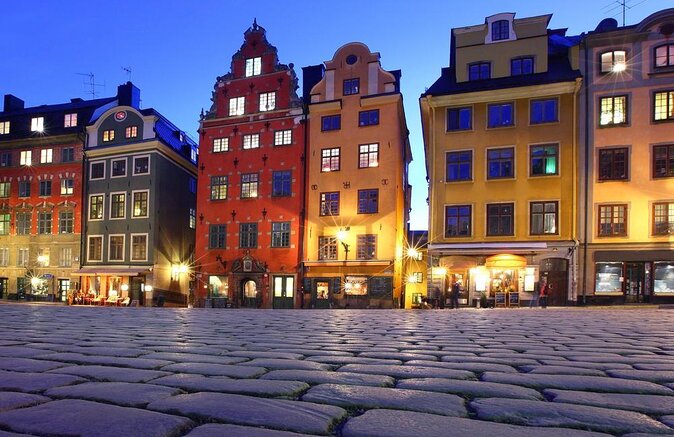
- Ends near Stortorget, timed so you can catch the changing of the guards in season.
Three chapters that make Stockholm feel like a timeline
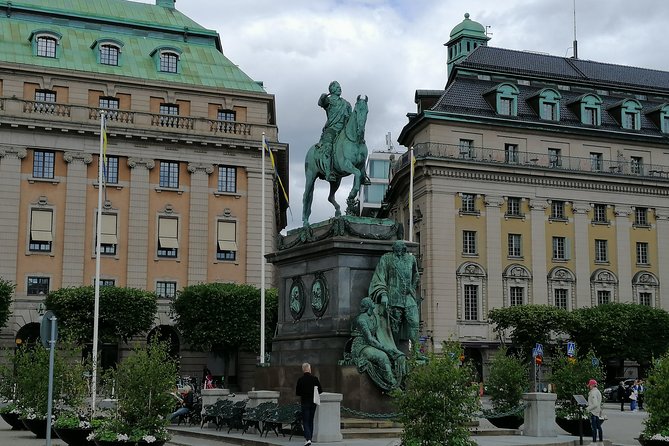
There’s a reason Stockholm can feel confusing at first. The city looks beautiful and layered, but most self-guided walks bounce between buildings without explaining what changed and why. This tour fixes that. You move through the Old Town area as if someone is building a timeline on the pavement.
The organizer frames everything as three chapters: origins and early settlement, the country becoming sovereign and reforming religion, then later political structure and enlightenment-era shifts that feed into the modern welfare state. By the time you’re near the Royal Palace and Stortorget, Sweden doesn’t feel like a faraway country from a textbook. It feels like a story that happened right here, with dates, personalities, and consequences.
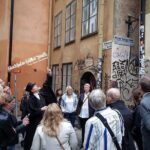
More laps of Gamla Stan and the old town lanes

Price and logistics: what $61.28 really buys
At $61.28 per person for about two hours, you’re paying for more than a route map. You’re paying for two things that are hard to replicate on your own without homework: guided interpretation and included entry at key points.
A nice practical touch is that you get a mobile ticket, which makes last-minute plans easier when your phone is already your wallet. Also, the stops include admission ticket-free entries along the way, which matters in busy Old Town areas. Even if you love walking, wasting time in lines is just friction. This tour aims to remove it.
Group size matters too. With a maximum of 10 people, you’re less likely to feel like a number in a moving crowd. You can ask questions, and the guide can pace the story without constantly stopping to regroup.
Chapter one: Riddarholmen and the early idea of Stockholm
The tour starts at the Gamla Stan Metro station area, inside/under ground, in front of the Pressbyrån kiosk. If you’ve ever arrived in Stockholm looking for the “right” entrance, this helps: you meet in a recognizable spot and then step out into the Old Town story.
Stop 1: Riddarholmen historical marker (and a look at palace spaces)
The first stop sets the tone: early history of Stockholm and Sweden, stretching back to the ice age and forward to the first settlement patterns on the islands. It’s the kind of framing that makes later buildings feel earned. You don’t just see stone and roofs—you understand why people ended up here.
Then you get a chance to walk around and visit open parts of the palace (the entry is included). It’s not a long museum day, but it gives you that “I’m inside the real place” feeling without turning the tour into a marathon.
What to watch for: when you’re early in the walk, listen for the guide’s bridge between geography and power. Stockholm’s island setting isn’t just pretty; it shaped who could rule and how.
Stop 2: Riddarholmen Church area and Birger Jarl’s signature moment
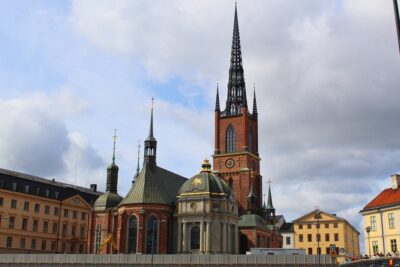
Next comes Riddarholmen, where the tour meets outside the church and points you toward the presumed founder of Stockholm—Birger Jarl—or at least the famous statue that stands for him.
This is where the tour anchors itself with a date: 1252, the year when Stockholm was first mentioned in a written text that’s preserved. The story then moves from that “first mention” to how power and paperwork helped turn a place into a city.
If you like history that connects to objects you can see (statues, church exteriors, named sites), you’ll enjoy this part. You’re not being asked to memorize; you’re being shown.



Chapter two: Gustav Vasa, the House of Nobility, and the reshaping of the state
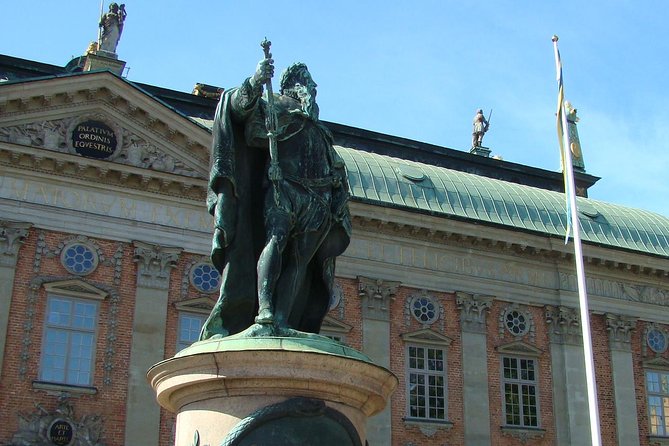
Chapter two starts outside Riddarhuset (the House of Nobility). Even from outside, it’s an important stop because it signals how Sweden organized authority. The guide uses the statue of Gustav Vasa, often described as the father of Sweden, to explain why the next century felt different.
Stop 3: Outside Riddarhuset with Gustav Vasa and the Bloodbath of Stockholm
Here’s the turning point theme: Sweden becomes a sovereign state, not occupied by foreign powers, starting with Gustav Vasa’s march into Stockholm in 1523.
Then the tour highlights a brutal but formative moment—the bloodbath of Stockholm—linked to an uprising against the southern neighbor that controlled Sweden at the time. The story doesn’t soften it. You get the contrast between political violence and national identity, and then you get another major change: Gustav Vasa also changed religion in Sweden from Catholicism to Lutheran Protestantism.
This is one of the most memorable stops because it ties together three things that often get treated separately in casual travel: statehood, religion, and legitimacy. And it all clicks into the city’s physical layout.
A practical note: this stop is short, around 10 minutes, so if you’re the type who likes to read every plaque in full, don’t plan to do that here. Use this moment to get the big picture.
Stop 4: Vasabron and the heirs of Gustav Vasa
From there, the walk continues across Vasabron, and the story shifts to Gustav Vasa’s heirs. The emphasis lands on Gustav II Adolf, described as a great warrior king, and how during his time the Baltic Sea became almost like an inland sea surrounded by Swedish possessions.
You’ll probably feel how the tour is designed: each stop gives you a new “chapter character,” then returns you to the big theme—Sweden’s power, challenged and reshaped over time.
Chapter three: from estates and voting rights to the Royal Palace and modern peace
After the Vasa story, the tour moves into governance and later political structure. This is where Stockholm starts to feel less medieval and more like the model for modern institutions.
Stop 5: Parliament building (Riksdagshuset) and how representation evolved
The stop at Parliament Building (Riksdagshuset) explains the predecessor system: the Riksdag of the Estates (Ståndsriksdagen). Nobility, clergy, burghers, and peasants met separately, then came together to discuss matters with the king in the palace.
You learn that until 1866, this institution held the highest authority next to the king. In 1866, a parliament with two chambers was introduced, but voting rights were still not equal for all citizens. The guide then brings you to 1921, when the first elections with general suffrage were held, after a long struggle led by liberals and socialists.
What I like here is how the tour doesn’t just list dates. It shows the gradual, uneven path from estate-based power toward broader voting. Even if you’re not a political-history person, this helps you interpret why Swedish governance looks the way it does today.
Stop 6: Royal Palace area at Lejonbacken and warrior kings vs. Peter the Great
Now you’re near the Royal Palace area, specifically at Lejonbacken on the north side. This section is dramatic by design: Peter the Great of Russia is presented as the turning point ending Sweden’s northern European great-power ambitions.
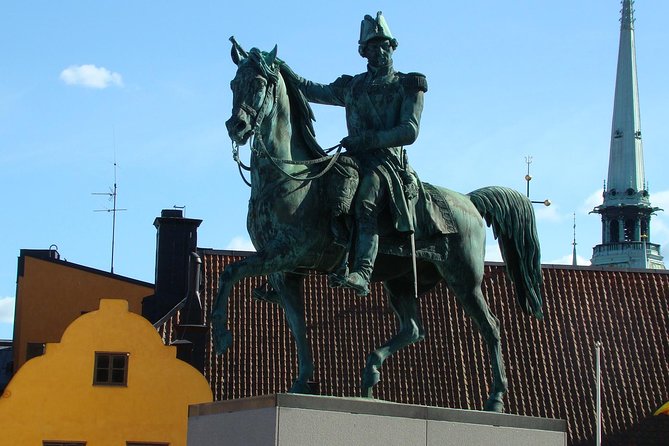
Then you meet Karl XII, the last of the warrior kings. The statue points east, toward where Karl and his army—the Caroleans—won early victories, before being defeated by Peter the Great at Poltava in 1709.
The story doesn’t stop at military setbacks, though. It pivots to the age of enlightenment, when arts and science drew more attention. The tour highlights Gustav III, described as an enlightened despot with an interest in theatre, and notes his contributions in those fields.
Even if you’re standing still, you can feel the shift in how Sweden wanted to project itself: from conquest to culture, from war results to ideas.
Stop 7: Stockholm Old Town and Carl XIV Johan to the 200 years of peace
Below the statue of Carl XIV Johan, the tour keeps the timeline moving. You learn he was the first of the Bernadottes, imported from France in the beginning of the 19th century to try to win back what Sweden lost to the Russians.
But the twist is practical: instead of focusing mainly on fighting, the guide connects his reign with diplomacy, infrastructure, and education. The story then jumps to a modern milestone: in 2014, Sweden celebrated 200 years of peace.
The tour then links industrial change and national resources to Swedish inventions and the foundation for a welfare state. It also touches on entrepreneurship continuing into the 20th and 21st centuries.
This is a section I think you’ll appreciate even if you’re not a policy fan. You get a sense of how long-term peace and economic shifts don’t happen by accident. They’re built from choices over decades.
Where it ends at Stortorget: Nobel steps and guard-changing timing
The tour wraps up at Stortorget, ending close to the Royal Palace. This is an intentional finale, because it lines you up for one of Stockholm’s most watchable routines.
Stortorget is also where the Nobel Prize Museum is located. The tour explains that the Swedish Royal Academies designate winners of Nobel Prizes across important categories in science and art. It’s a strong way to end: you began with early settlement and documents, and you finish with modern institutions tied to global recognition.
The timing is another useful detail. The tour ends in what the guide calls perfect timing to see the changing of the guards. In summer months, the parade marches or rides with the Music Corps through up to the palace’s outer courtyard (weather and exact schedule can vary, but the tour is clearly designed with this in mind).
If you want great photos, position yourself soon after finishing, not five minutes later. These spots fill fast when the parade starts moving.
Is this tour worth it? My value check
For $61.28 over about two hours, the value comes from the mix: included entry, a tight narrative, and a small group cap of 10. If you tried to stitch this together on your own, you’d likely spend extra time on research, and you’d still face ticket-line friction at the stops that require it.
You should book this if:
- you want a guided story that turns landmarks into meaning
- you like learning about rulers, religion shifts, and political evolution through specific places
- you want a group experience without a huge crowd
You might not love it if:
- you prefer long independent wandering over frequent stops and explanations
- you’re looking for a purely scenic walk with minimal historical talk
Should you book this tour?
Yes, if you want Stockholm to make sense quickly. This walk is built like a timeline you can hold in your head: origins at Riddarholmen, the Gustav Vasa turning points at Riddarhuset and nearby, and then politics and modern identity near the Riksdag and Royal Palace. The included admission helps you keep pace, and the small group size makes it easier to engage.
If your plan is short on time, you’ll also like the idea of doing a shorter version if your schedule doesn’t allow the full walk. The best-case scenario is you leave with a clearer map of how Sweden’s identity evolved—from early mentions of Stockholm to the institutions at Stortorget.
FAQ
FAQ
How long is the walking tour?
It lasts about 2 hours.
Where does the tour start and end?
It starts at Gamla Stan Metro station (inside/under ground, in front of the Pressbyrån kiosk area) and ends near Stortorget by the Royal Palace.
How much does it cost?
The price is $61.28 per person.
Is it offered in English?
Yes, it’s offered in English.
What group size should I expect?
The tour is capped at a maximum of 10 travelers.
Is admission included?
Yes. The tour notes that admission tickets are free along the way, and it mentions included admission as part of the experience.
What level of walking or fitness is required?
It’s listed for people with a moderate physical fitness level.
Can I get a refund if I cancel?
Yes, there is free cancellation. You must cancel up to 24 hours in advance for a full refund.
If you want, tell me what month you’re going and whether you care most about monarchy, religion, or politics. I’ll suggest the best time to do this so you can pair it with the Royal Palace area after the tour.
More Tours in Stockholm
More Tour Reviews in Stockholm
More Gamla Stan Walks

Just Added: The Latest Stockholm Reviews









Gamla Stan Old Town Walks, compared.
 ★ 4.7Ghost Walk and Historical TourFrom $312,206 reviews
 ★ 5.0Walking Tour of Stockholm Old TownFrom $241,175 reviews
 ★ 4.5The Original Stockholm Ghost Walk and Historical Tour – Gamla StanFrom $381,165 reviews
 ★ 4.7Old Town Walking Tour with Local GuideFrom $15719 reviews
 ★ 5.0Best of Stockholm Walking Tour-3 Hours, Small Group max 10 peopleFrom $49645 reviews
 ★ 4.5The Nordic Food Walk StockholmFrom $122642 reviews
 ★ 5.0Walking Tour of Stockholm’s Old Town, Gamla StanFrom $13451 reviews
 ★ 4.9Old Town Historical Walking TourFrom $52344 reviews
Browse the lists this tour appears in